
Closeness is not hours together
Closeness tracks attention rather than proximity, so here is what the research on responses and phone use found, and the ten-minute experiment to run this week.
- autopilot
- hermes
- connection
What you get from this
- Closeness is paid for in small turns toward each other, not in hours spent in the same room.
- In a study of couples in the Journal of Personality and Social Psychology, engaged responses to good news went with higher satisfaction, intimacy and trust.
- In a Baylor survey, more phone use a person reported in a partner during time together went with lower relationship satisfaction.
- Ten minutes, phones in another room, one real question each, and no solutions from the listener.
- Say nothing for five seconds after the answer. That pause is the part the ten minutes is testing.
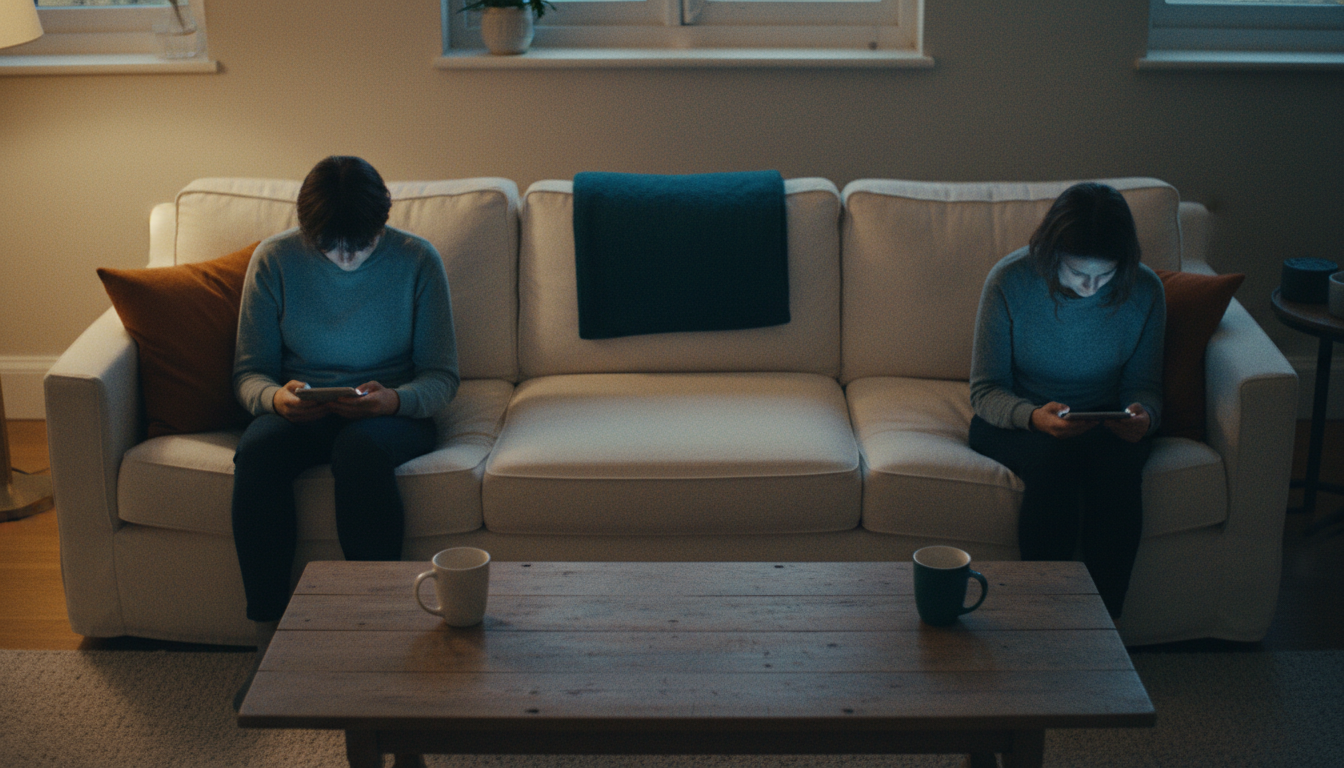
You are in the same room all evening. Two laptops open, one phone charging on the arm of the sofa, and the last thing you actually said to each other was about the bins. By eleven the day is over and neither of you could say what the evening was for.
The question underneath that is not whether you spend enough time together. That one has a number attached, and you can find it in the calendar. The harder question is whether any of that time was aimed at the other person. Being near someone and paying attention to them feel identical from the inside, and they are not.
Your partner reads attention, not hours
Start with what happens when one person brings home good news. In a study of couples published in the Journal of Personality and Social Psychology, the psychologists Shelly Gable, Harry Reis, Emily Impett and Evan Asher asked partners how the other one responded when something went right. The engaged response, the one that asked a question and stayed with it, went with higher satisfaction, intimacy and trust, and the flat response, the "that is nice" delivered without looking up, went with lower scores on all three in the same study. The research is correlational, so it describes a pattern rather than proving a direction, and the pattern is worth sitting with.
Read that as a description of an entire evening and the shape of the problem appears. The nod, the "mm", the listening face worn while scrolling: that is not a smaller version of attention. It is a different signal, and it is the one that arrives.
Why the room is not the unit
There is a second study worth holding next to the first. In a survey of adults in relationships, published in Computers in Human Behavior, the researchers James Roberts and Meredith David at Baylor University found that the more phone use a person reported in a partner during time together, the lower that person's relationship satisfaction, with the link running through the conflict over phone use. It is a survey, so it cannot say which came first, the phone habit or the unhappiness. It says the phone in the middle of shared time is part of how a couple reads the relationship, not a neutral object in the room.
Put the two together and the accounting is not about hours. A long evening together supplies a great many small chances to turn toward each other, and a screen in the room takes them one at a time without either person noticing. Ten minutes with the phones in another room supplies fewer, and nothing in the room competes for them. The evening is not worth more because it is longer. It is worth more when something in it was aimed at the other person.
Why this is harder than it sounds
Shared time is easy to schedule. It needs no agreement about what the time is for, and it gives the pleasant sense of having spent the evening together without asking anything of either of you. Attention is harder, because it is a request. To sit down with no screen and ask a real question is to say out loud that the other person is the most interesting thing available, and to be available in the same way back.
That is also where the discomfort sits. Ten minutes of this can feel staged, and either of you can say so out loud. Staged is what a first attempt looks like.
The experiment: ten minutes at the table
Pick a regular moment rather than a romantic one. After the dishes, or once the last child is down, or at the kitchen table before either of you opens a laptop. Ten minutes. Both phones in another room, not face down on the table, because face down still means in the room. One question each, and the listener does not solve anything.
The Gottman Institute teaches a longer version of this as the stress-reducing conversation: about twenty minutes in which one partner talks about the day and the other listens without offering advice. Twenty minutes is a good target later on. Ten is the size that survives a Tuesday.
The question matters less than the rule. "What was the worst ten minutes of your day" works. So does "what are you carrying that I do not know about". Whoever answers gets to finish. Then the other one says nothing for five seconds after the last word, and that pause is the part the ten minutes is testing.
What to notice
Afterwards, notice two things. Whether the conversation went somewhere the evening usually does not, and how long it took to get there. One line in a notes app each night for a week is enough of a record to see the shape of it.
If a week of this changes nothing, that is information too. A ten-minute conversation can go thin because something older is sitting under it, and that is work for a couples therapist rather than a note.
Each Sunday: one question to ask your partner, the research behind it, and one thing to try. The free Relationship Checkup is open to everyone, any time.
One question a week.
Each Sunday: one question to ask your partner, the research behind it, and one thing to try. The free Relationship Checkup is open to everyone, any time.