
Date night when dinner has stopped working
Dinner across a table asks both of you to hold eye contact and invent the conversation, so here are four evenings chosen for what each one does to the talking, and the walk to try this week.
- autopilot
- hermes
- couple-habits
What you get from this
- Dinner across a table asks both of you to face each other and invent the conversation. The format suits whoever had the good week.
- The question carries an evening more than the food does, and a restaurant menu gives you almost no prompts to answer.
- Change what the evening asks for: something for your hands, no eye contact to hold, and a prompt that is not about the household.
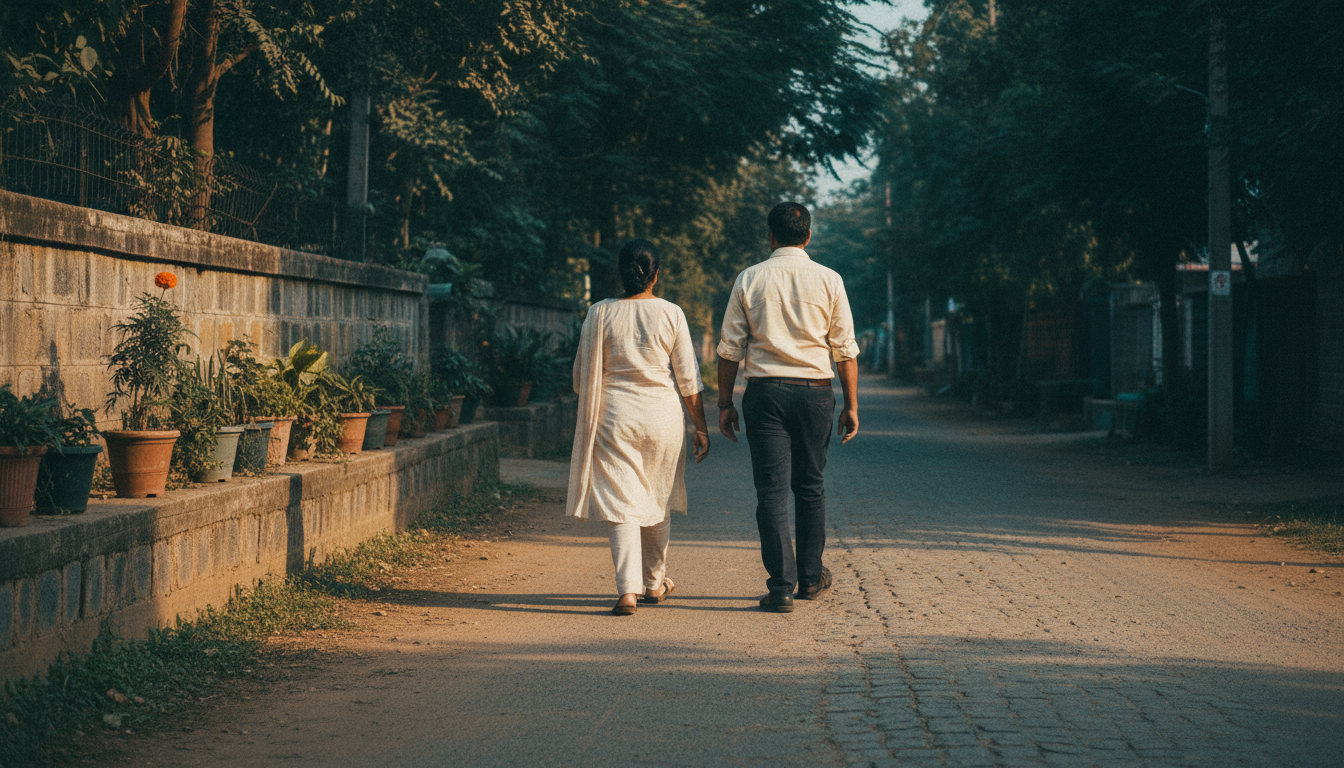
- Try the walk: twenty minutes after dinner, side by side, eyes on the road. Say the thing on the second loop of the park.
- Say this first: "Let us walk for twenty minutes after dinner. I want to tell you something I have not said at the table."
You have the table booked for eight. You sit down opposite each other and the menu gives your hands something to do for a few minutes. By the time the food arrives, the conversation has settled into the same channel it runs into every Friday: the week, the children, the thing your mother said on the phone.
It is not that the two of you have run out of things to say. It is that a restaurant table is a particular and demanding place to say them.
Why the table is the hard part
Dinner across a table asks both of you to face each other and hold attention. You keep your eyes on each other, keep a thread going while a waiter comes and goes, and look for something to say that is interesting enough to be worth the evening. The format suits the person who had a good week. The person who did not has to improvise.
Notice what the table is asking of you. It wants a summary of the week, in a shape the other person can react to. That is a small performance, and both of you are on stage for it.
Two things carry a conversation, and neither of them is the food.
The first is the question. In a 1997 experiment by Arthur Aron and his colleagues, pairs of people who had just met were given a set of questions that grew steadily more personal, and they answered them in order. After one session together, those pairs reported feeling notably closer to each other. The questions were carrying more of that closeness than the room was. An evening hands you whatever prompts it contains, and dinner contains very few.
The second is where your eyes and your hands are. Facing each other across a table is the hardest position from which to say the thing you have not said. It is also the one with nowhere to look once you have said it.
So the point of a different evening is not to find somewhere new. It is to change what the evening asks of you: fewer prompts to invent, less eye contact to hold, something for your hands to do.
Four evenings, and the job each one does
The walk after dinner
Side by side, moving, no eye contact required. This is the one for the sentence that has been waiting. You look at the road instead of at a face, and the second loop of the park gives it room. A silence has somewhere to go, because your feet are already doing something. Twenty minutes is plenty.
The counter, not the table
Cook dinner at the counter together instead of ordering in, even on a weeknight. Your hands are busy and there is a small task in front of you both, which is an easier thing to talk across than a blank hour. You can stand close without either of you having to sit and look attentive.
The long way home
Take the drive, or the cab, the long way. You are side by side in the dark, with a fixed stretch of time and nothing else either of you can do in it. The road does the work of filling the pauses. The conversation has a beginning and an end built in, and that is the whole point of it.
The one-question drink
Sit somewhere side by side with one rule. Each of you brings a single question that is not about the household, and you take turns answering it. The rule does what the menu does not: it hands both of you a prompt, so neither of you has to invent the evening.
The one to try this week
Start with the walk. It asks the least of a weeknight.
Before you go, say this to your partner: "Let us walk for twenty minutes after dinner. I want to tell you something I have not said at the table."
Then walk, and on the second loop of the park, say the thing. If you are the one being told, let them finish and then say nothing for ten seconds before you answer. That silence is the hardest part of the whole exercise.
What the first try feels like. It feels staged at the beginning, and the feeling passes. The first few minutes may go to the week, the children and the phone call. Notice whether the harder sentence is easier to say with your eyes on the road instead of across a table.
After the walk, take one minute each to say what the walk was like rather than what it solved. The first try is a test of the format, not of the two of you.
Each Sunday: one question to ask your partner, the research behind it, and one thing to try. The free Relationship Checkup is open to everyone, any time.
One question a week.
Each Sunday: one question to ask your partner, the research behind it, and one thing to try. The free Relationship Checkup is open to everyone, any time.