
How to raise a hard thing
The first sentence of a hard conversation decides what the next ten minutes are about, so here is an opening that raises an issue without a verdict, the two openings that reliably start a fight, and one ten minute version to try this week.
- autopilot
- hermes
- communication
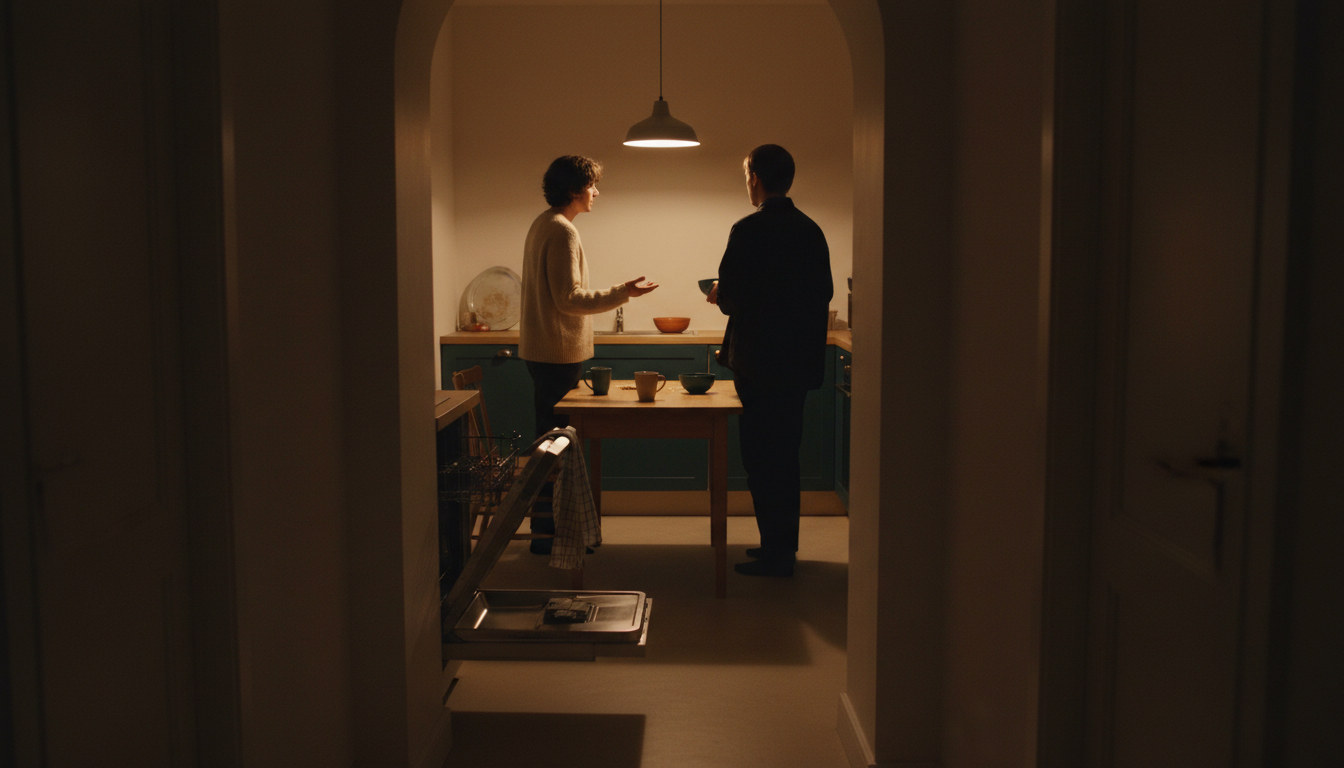
It has been sitting there for four days. A small thing you keep meaning to raise, and you keep finding reasons to wait: not tonight, they had a long day, the mood is finally good. Then on Thursday at ten past ten, in the kitchen, with the dishwasher open, it comes out as a verdict. The next forty minutes are about the verdict, and the thing you wanted to raise never gets raised.
The question is not how to want to talk about it. You already want to. The question is what your first sentence is, because that sentence decides what the next ten minutes are about: the thing itself, or whether you were allowed to bring it up.
Why the first sentence carries so much
John Gottman's observational work is where most of this starts. He and his colleagues recorded couples working through real disagreements and coded, second by second, what happened. In his account of those recordings, a conversation that opens with criticism or contempt tends to escalate, and the alternative he recommends, which he calls a soft startup, opens with what the speaker noticed and how it landed rather than with a claim about who the other person is. That is his framework, built from decades of studying couples, and it is why the first sentence is treated as a variable at all rather than as decoration on the real conversation.
The other half of the explanation is about how a sentence gets heard. Frank Fincham and Thomas Bradbury, reviewing the research on attributions in marriage, describe a difference that shows up reliably between distressed and non-distressed couples: in that review, distressed couples are more likely to read a partner's irritating behaviour as a stable feature of their character than as a reaction to a particular day. The finding is correlational. It does not show that your wording changes your relationship. It shows that the two travel together, which is a better reason to watch your sentences than to wait for a better mood.
The opening that works
The move has three parts and fits in two sentences.
Say the moment, not the pattern. "When you took that call at dinner on Tuesday" is answerable. "You are always on your phone" is not, because a pattern can only be denied.
Say your side, not their character. "I felt like I was talking to the back of your head" is something a person can take in. "You were rude" is a judgment on who they are, and a judgment tends to leave only two moves: defend, or counter-attack.
Then ask for the conversation instead of delivering it. "I want ten minutes on it, and I would rather it was not right now if right now is bad." That sentence is the line between raising something and ambushing someone.
Said out loud, the whole thing sounds like this. "There is something small I have been carrying. When you took that call at dinner on Tuesday, I felt like I was sitting there on my own. Can we have ten minutes after the kids are down?" Two sentences of content, one of logistics, no verdict anywhere.
The two openings that turn it into a fight
The first is the character verdict: "you never", "you always", "you are the kind of person who". It opens a fight because there is very little else to do with it. The pattern behind it came from somewhere real, and that is the trouble: a pattern is an accumulation, and an accumulation cannot be said out loud in one line. It has to be boiled down to the most recent instance, which is also the only version the other person can answer.
The second is the ambush: in a doorway, on the way out of the house, at eleven at night, or in the one hour a week you both have to yourselves. The wording can be perfect and the conversation still goes nowhere, because the person answering is tired, or mid-task, or braced for a completely different day. Choosing the hour is half the work, and asking for the hour costs one sentence. It also changes who decided.
One thing to try this week
Pick the smallest thing you have been carrying. Ask for ten minutes at a time you name out loud, tonight or tomorrow. Open with the moment, then your side, then stop and count to five silently before you say anything else.
Afterwards, notice two things. Whether the first thirty seconds stayed on the subject, or slid onto whether you were allowed to raise it. And whether the other person's first reply was a defence or a question. A question early is the thing to look for, because it means the sentence was heard as information rather than as an indictment. A defence is information too, and it usually means the verdict, not the moment, is what got answered.
If the ten minutes turns into the old argument anyway, then that is what happened, and it says the subject is bigger than one opening. Say so out loud at the end, plainly: "I think this one is bigger than I thought it was." That is a sentence about the subject, and it keeps the subject open instead of closing the file on it.
What this will not do
It will not make the conversation comfortable, and it will not produce an agreement tonight. Two people can open the right way and still disagree, and disagreeing after a sentence that was not an accusation feels different from disagreeing after one that was.
It will not work on a conversation that is being avoided for a reason, either. If raising small things at all is expensive, or if you shape your week around avoiding a reaction, that is not a wording problem and no arrangement of sentences will fix it. This is relationship education, not therapy or medical advice. If any part of this describes what is happening in your relationship, a qualified professional or a local support service is the right next step, and not an article.
The free Relationship Checkup is open to everyone, any time.
One question a week.
Each Sunday: one question to ask your partner, the research behind it, and one thing to try. The free Relationship Checkup is open to everyone, any time.