
The EMI talk that turns into 'your family'
When the EMI talk keeps ending at 'your family', two talks are being held as one. Here is where the loop can be cut, and a monthly fifteen minutes that keeps the money talk small.
- autopilot
- hermes
- couple-habits
- stock-2026-10-06
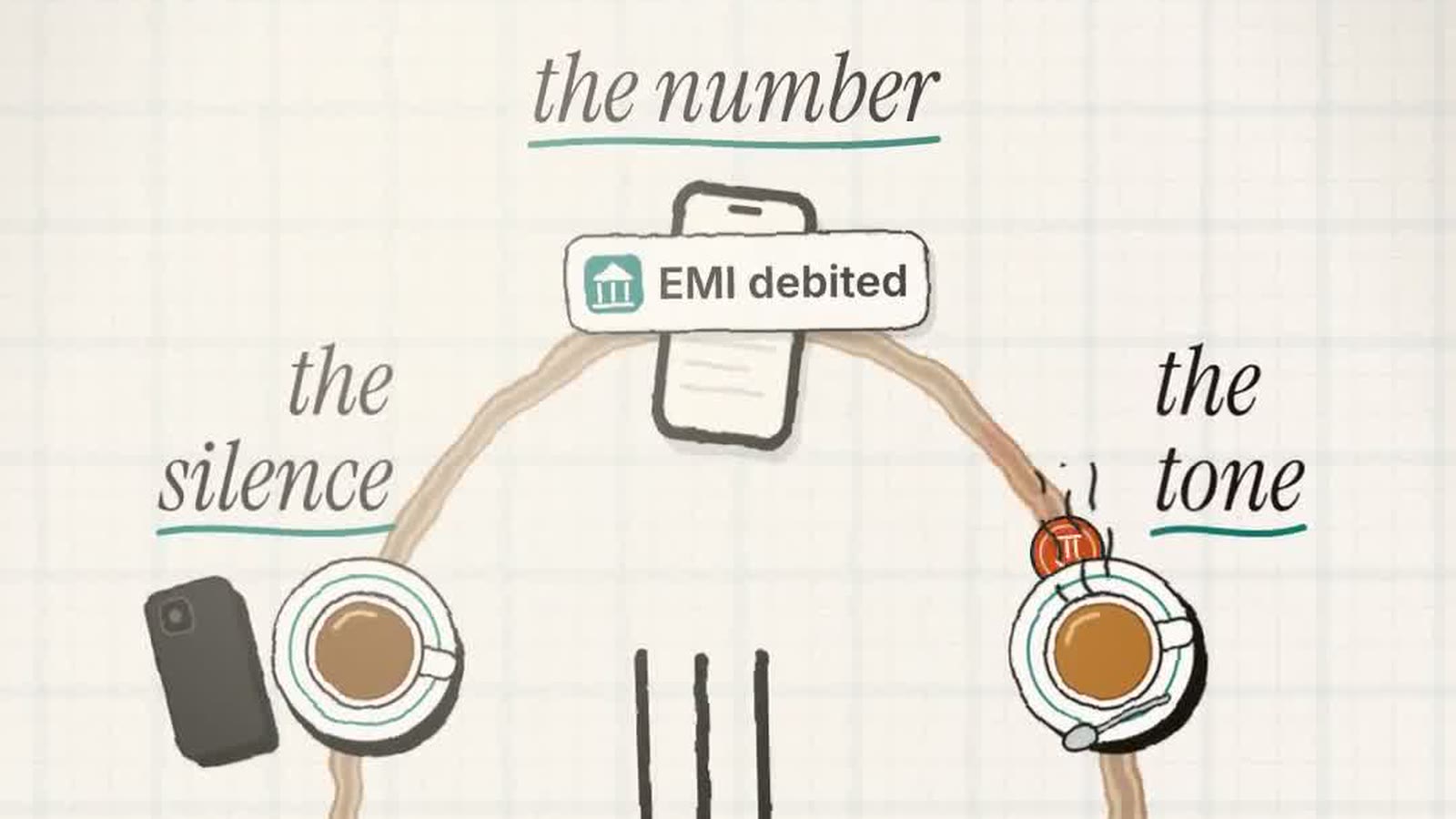
You start with the EMI. The message from the bank lands at dinner: EMI debited. One of you says, "We need to be careful this month." A fair thing to say. Ten minutes later you are at his brother's loan, the one from three years ago that never came back. Then somebody says "your family", and after that nobody says anything. The phone goes face down. The tea goes cold. Nothing about this month has been decided.
Next month the message comes again, and so does the fight. By the third month you both know the route.
So here is the question. Why does a talk about one number keep ending at "your family"?
It is not one talk. It is a loop.
Look at the route slowly, because it is the same each time.
It starts with the number. The EMI, the school fees, the money sent home. A number is small. It has a size and a date.
Then comes the tone. "We need to be careful" can be heard as "you are not careful". Nobody said that. It is heard anyway.
Then the old story walks in. His brother's loan. Her sister's wedding. The thing from three years ago that was never finished. It was waiting for a door, and the number opened it.
Then "your family". Now it is not about this month at all. It is about whose people matter more, and who is on whose side.
Then the silence. Nothing decided, both hurt. And the number is still there, so next month the loop starts again from the top, a little faster, because you both already know the way.
What is underneath
The EMI is about money. "Your family" is not. It is about fairness and loyalty: do my people count as much as yours, and are you with me. Those are big questions, and they need their own evening. They cannot be settled in the gap between a bank message and the dal.
There is some research on this, and it is worth saying plainly what it does and does not show. In a diary study of a hundred married couples in the United States, published in 2009, the psychologist Lauren Papp and her colleagues found that arguments about money were more likely to recur and to be left unresolved than arguments about other things, even though the couples made more attempts to solve them. That is one study, of American couples, and it does not say why. But it fits what the loop looks like from inside: the talk about money keeps coming back because it never ends as a talk about money.
So the trouble may not be the EMI, and it may not even be the brother's loan. It may be that two talks keep getting held as one.
Where the loop can be cut
Go round once more and look for the weak point. It is not at "your family". By then both of you are hurt and it is late in the evening. It is not at the silence either.
It is earlier, between the number and the old story. There is one moment when a second subject tries to enter. That is where the loop can be cut, with one sentence:
"That is a separate talk. Tonight is only this month."
This is not a way to shut the other person up. The brother's loan is real and it deserves a hearing. It simply does not get heard well at the end of an EMI talk. So it is written down, on paper, where both of you can see it, and given its own day.
The one thing to try: the monthly fifteen minutes
Pick one fixed day a month. The first Sunday works, after chai, before the day gets busy. Sit at the table with two cups and the month's numbers. Set a timer for fifteen minutes.
There are three rules.
- Only this month. What has to go out, what is coming in, and what is tight. Not last year, not three years ago.
- Each of you finishes one sentence. "This month, the thing I am worried about is…" The other one only listens, and then it is their turn. Both of you speak. Both of you see the same numbers.
- Anything about family goes on the list. When the brother's loan or the money sent home comes up, either of you can say it: "That is a separate talk. Tonight is only this month." Write it on a sheet marked "For another day", and pick the day before you get up.
When the timer rings, stop, even in the middle. A short talk that ends on time is easier to come back to next month than a long one that ends in silence.
Notice one thing afterwards: did the talk stay about this month? That is the only score.
The first time feels staged, like a meeting in your own house. One of you may laugh at the timer. That is the awkward part, and it passes.
One more thing, said plainly. This note is for two people who both see the money and both have a say, and who keep getting pulled off the subject. It is not about what to do with a loan. If money in your home is hidden from you, decided without you, or something you are afraid to ask about, that is a different situation and this note is not for it. This is relationship education, not therapy or medical advice. If any part of this describes what is happening in your relationship, a qualified professional or a local support service is the right next step, and not an article.
Each Sunday: one question to ask your partner, the research behind it, and one thing to try. The free Relationship Checkup is open to everyone, any time. Take the Relationship Checkup
One question a week.
Each Sunday: one question to ask your partner, the research behind it, and one thing to try. The free Relationship Checkup is open to everyone, any time.