
The story you tell about your relationship
The way a couple tells the story of their own past tracks with how the marriage is doing, so here is what researchers coded for in those tellings, what the work cannot claim, and one retelling exercise to try this week.
- autopilot
- hermes
- relationship-psychology
What you get from this
- Buehlman and Gottman recorded couples telling the story of their marriage in the early 1990s and scored the shape of the telling, not the facts.
- What they listened for was a running we rather than I and he, and a hard year described as something both of them carried rather than as chaos.
- The couples were followed afterwards and the scored tellings tracked with which marriages later held, which is not to say a retelling rescues one.
- Tell one hard year in turns, ten minutes each, correcting no facts, then name three things you did between you and say them as we did that.
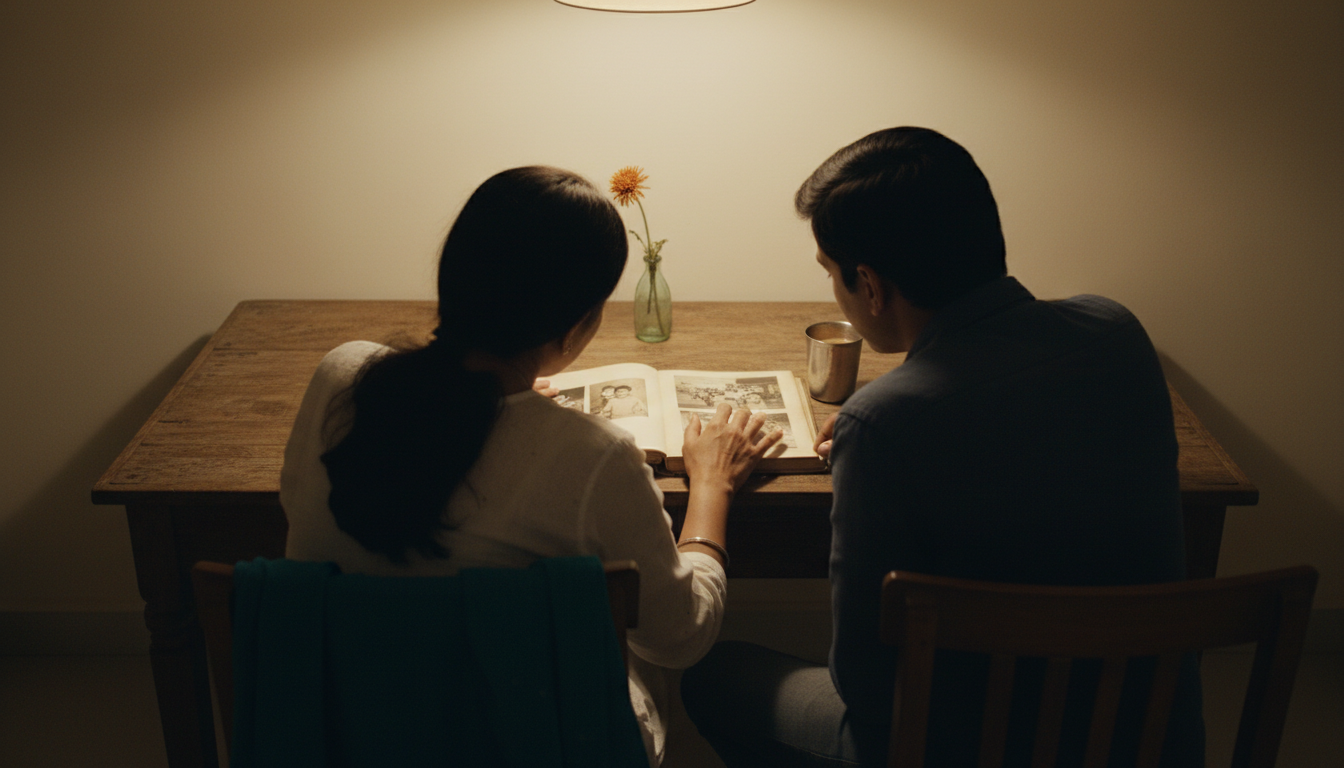
Ask two people who have been together a long time about the same bad year and you get two accounts that share only the dates. One of you says it was the year your father was in the hospital and we barely spoke. The other says it was the year we somehow kept the house running. Nobody is lying. Both of you were there.
That gap is not only a memory problem. It is the story of the relationship, and it gets written continuously, out loud, at a wedding or over chai, whenever somebody asks how you met. The surprising part is what researchers found when they started listening to that story on purpose.
What the researchers listen for
In the early 1990s, Kim Buehlman and John Gottman, then working at the University of Washington, recorded couples talking through the whole history of their relationship: how they met, how they decided to marry, what the hardest years had been like. They called it an oral history interview, and they did not code it for facts. They coded the shape of the telling. A couple whose account ran on we, we were broke, we moved in with my parents, we got it back, was coded differently from a couple whose account was all I and he and it worked out. A year described as something the two of them carried was coded differently from a year described as chaos that arrived from outside and left.
Each interview was scored by hand against a long list of dimensions, and the couples were followed afterwards. The shape of the telling, as it was scored in those first interviews, tracked with which of them later separated.
Where that work stops
Two limits are worth holding on to. The study was small, a few dozen couples interviewed in one lab in one city, and both partners were recalling years they had already lived, so what got coded was memory rather than the year itself. And a story and a marriage move together. Nothing in that work shows which one is the cause, and nobody in it asked a couple to retell a chapter and then watched what happened.
What is left is narrower and more useful than it first sounds, and it is worth calling an idea rather than a finding. The version you keep telling is not a neutral record of what happened. It is one of the ways the two of you agree on what you have been through, and an agreement can be revised. A story in which the hard year happened to you is a story with nothing in it that you did.
One thing to try this week
Pick one year you both already agree was hard. Not the worst thing that has ever happened to either of you, just a hard one: a job that ended, a wedding week that went sideways, the first year with a baby and no sleep, the year of the hospital.
Then, on a Sunday morning or any evening when the dishes are done and nobody is leaving the room, tell it in turns. Ten minutes each. The one rule is that the listener does not correct a fact. It was Tuesday, not Monday. We stayed a week, not three days. Facts can wait. You are listening for the place where the account turns from what happened to you into what the two of you did.
Then take a second pass at the same year, and find three things that were done by both of you. The calls that were made from the hospital corridor. The money that got moved. The nights one of you took the baby so the other could sleep. Say them out loud in the we: we made those calls, we moved that money, we took those nights in turns. Not because it is cheerful, but because it is accurate, and the accurate version is the one you can both stand inside.
Then write down the single line you would give a friend at a wedding. The year my father was ill, and we kept the house running.
Notice one thing afterwards, and it is not how you feel about the year. It is whether the two tellings, yours and theirs, landed in the same place. The first time will feel staged, and the words will sound borrowed from somebody else's marriage. That passes. What you have afterwards is one more version of that year than you had before, and you get to decide which one you reach for the next time somebody asks.
Each Sunday: one question to ask your partner, the research behind it, and one thing to try. The free Relationship Checkup is open to everyone, any time.
One question a week.
Each Sunday: one question to ask your partner, the research behind it, and one thing to try. The free Relationship Checkup is open to everyone, any time.