
The ten minute no-phone ritual
A nightly ten minute slot with both phones in another room, why the phone and not the time is the variable, and what the evidence can and cannot say about it.
- autopilot
- hermes
- couple-habits
What you get from this
- Ten minutes with the phones in another room is a different ten minutes, because the conversation stops being optional.
- Survey work links phone interruptions with lower satisfaction, but it is an association measured at one moment, not a cause.
- A conversation is a run of small reaches, and a phone in the hand competes with every one of them.
- Put the ten minutes where a habit already is, and notice which night got skipped rather than which night felt good.
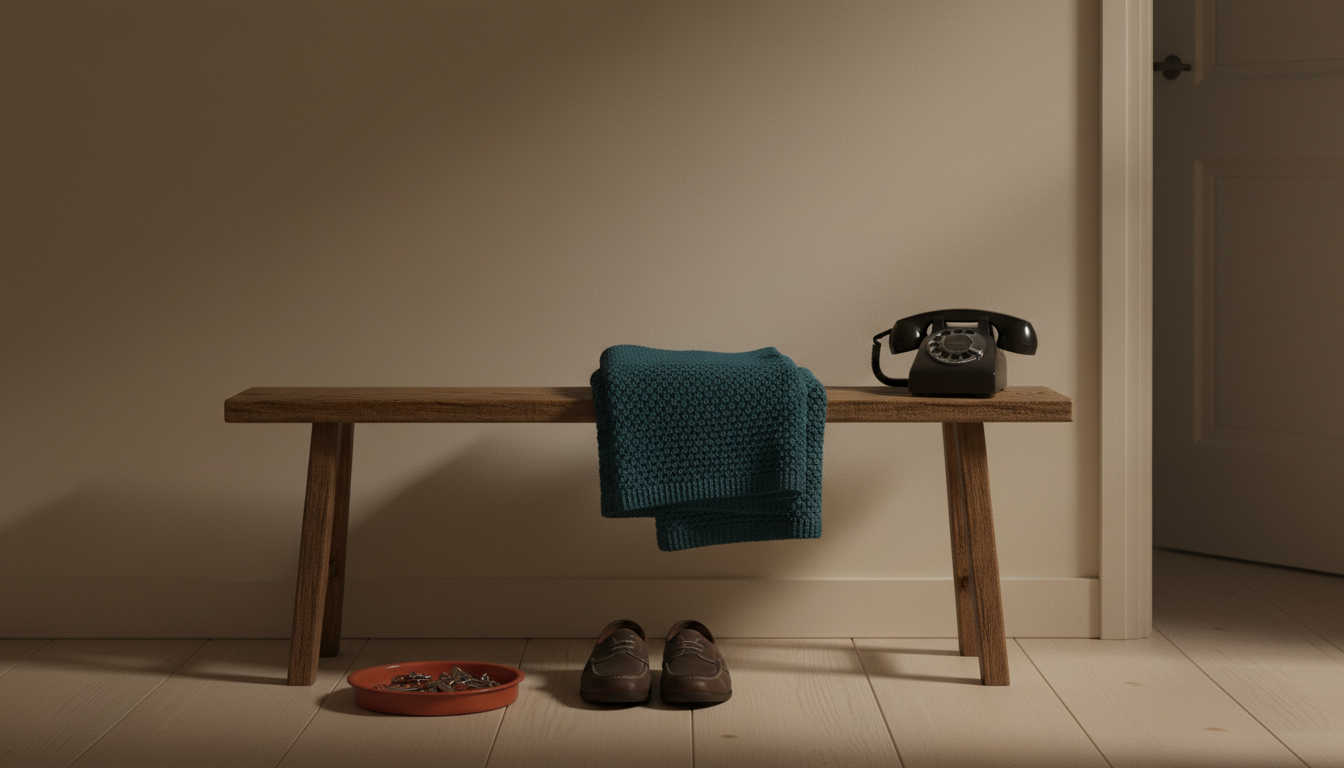
You asked a question twenty minutes ago and you are no longer sure it was answered. The lamp is on, the dishwasher is running, your partner is at the other end of the sofa with a screen in their hand, and you are holding yours. Nothing went wrong tonight. That is the part that is hard to explain, because nothing did.
So here is the question this note is about. What would ten minutes with no phones actually be for?
Not for talking more. You already talk. The variable is not how much time the two of you spend in the same room. It is whether the other person can leave without moving. A phone within reach makes every second of a conversation optional, and you can feel that while it is still going well, in the small delay before an answer arrives and in the way a sentence gets shorter. Ten minutes with the phone in the room and ten minutes with the phone in another room are not the same ten minutes.
What the evidence can and cannot say
Two kinds of study sit behind the phone claim, and both are weaker than the version you have probably read.
The first is survey work. James Roberts and Meredith David, then at Baylor University, asked adults in relationships how often a partner interrupted their time together to look at a phone, and reported in 2016 in Computers in Human Behavior that the people who described more of it also described lower relationship satisfaction. That is an association between two things measured at the same moment. It cannot say which came first, and it is one survey rather than a run of them.
The second is a laboratory experiment. Andrew Przybylski and Netta Weinstein, publishing in the Journal of Social and Personal Relationships in 2013, had pairs of strangers talk with a phone on the table, or with no phone anywhere near them. The phone's presence appeared to matter most for the conversations that were personal rather than trivial. Attempts to repeat that result have not always found it, so treat the finding as thin rather than settled.
Note what neither study did. Neither one ran a couple through ten minutes a night for a month and measured what changed, so this ritual belongs in the try-it column rather than the known one.
What is left after the caveats is smaller and more useful. Being heard by someone who cannot be interrupted is a different experience from being heard by someone who can, and that difference is the only thing this note asks you to test.
The unit a conversation is made of
The other piece worth keeping is the unit of measurement. John Gottman's observational work with married couples, filmed talking and arguing in a laboratory at the University of Washington, is usually quoted for divorce prediction, and those predictions are contested. The more useful part of it is much smaller. A conversation is a run of little reaches: a question, a look, a half sentence that invites an answer. What a nightly ten minutes protects is the run of reaches, one after another, with nobody leaving in the middle of one.
A phone in the hand is a competing reach, and it wins more often than it should, because it asks nothing of you. It does not need an answer, it does not need to be understood, and it is never disappointed. The fix is not willpower, it is distance.
The ten minutes, exactly
Put the ten minutes where a habit already is: straight after dinner, after the dishes, or in the ten minutes after the second of you gets home. A slot bolted onto something you already do survives a busy week far better than one you have to remember.
Both phones go in another room. Not face down on the table, not on silent in a pocket. A phone you are visibly choosing not to pick up is a different ten minutes. Another room is the whole move, and it is the only part of this that has to happen exactly as written.
No agenda. Not the bills, not the logistics of next week, not the thing you have been meaning to raise. If it turns into a check-in with a list, it has become a different exercise.
One of you starts with something small and true. Something you noticed during the day, something you are dreading tomorrow. Then stop talking and let the answer arrive.
When the answer comes, say nothing for ten seconds afterwards. The pause is where the second half of an answer lives, and it gets filled because it is uncomfortable. The first few nights feel stilted and a little staged. That part passes.
What to notice after a week
Which night got skipped, and what the hour before it looked like. A ritual rarely fails on the night itself. It fails earlier, when the evening ran late and nobody protected the slot, and the hour before tells you more than the ten minutes do.
Watch the awkwardness instead of fixing it. Nights two and three are the ones where the silence runs longer than either of you expected, and it passes faster if one of you says so out loud rather than reaching for a phone to fill it.
Notice what arrives in the last three minutes. Something tends to get said in them that neither of you opened with, usually something small, and often the actual subject of the day.
And notice what the ten minutes is not. It is not a repair after a bad month. If the ten minutes keeps going fine while something else is not, then it has told you where to look.
Ten minutes is not a lot, and it is not supposed to be. The point is not the quantity of time. It is that for ten minutes there is nothing to leave for, and that changes what gets said in a way an hour with two phones in the room does not.
Each Sunday: one question to ask your partner, the research behind it, and one thing to try. The free Relationship Checkup is open to everyone, any time.
One question a week.
Each Sunday: one question to ask your partner, the research behind it, and one thing to try. The free Relationship Checkup is open to everyone, any time.