
What relationship research can and cannot predict
A famous prediction number for divorce came from a model scored on the same couples it was built from, so here is what those studies measured, where the accuracy goes, and one ordinary evening habit to keep.
- autopilot
- hermes
- relationship-psychology
What you get from this
- The 93 percent divorce prediction comes from 79 couples followed for fourteen years by John Gottman and Robert Levenson.
- That model was scored on the same couples it was built from, and on a fresh sample a similar flag was right 29 percent of the time.
- In that study, the couples who split after many years went flat in ordinary talk rather than fighting openly.
- This week, four evenings, an hour before bed: ask your partner what the worst ten minutes of their day was.
- Then say nothing for a slow count of five, ask what made it that way, and leave it there. It will feel staged at first.
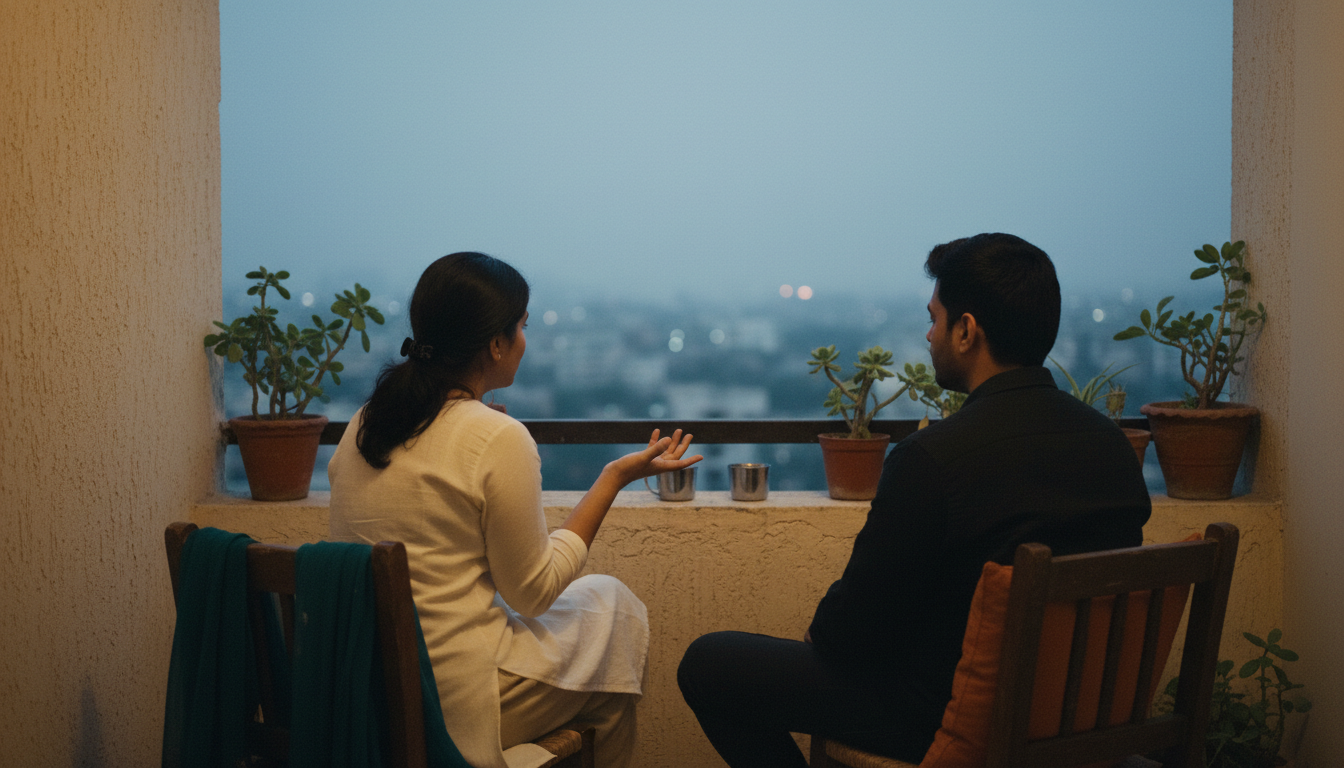
A friend forwards you the article. It rests on a number from John Gottman and Robert Levenson, who watched couples argue in a lab and then followed them for fourteen years. Their model called which marriages would end with 93 percent accuracy. The number is real and it is in the paper. What the paper measured is a narrower thing than the headline that carries it.
Which leaves the question you actually have. Does a lab session about somebody else's marriage tell you anything about your own last argument, the one that started because the cab came late and ended with both of you looking at your phones?
The study behind the number
In 1983, Gottman's lab at the University of Washington and Levenson's at Berkeley recruited 79 couples living around Bloomington, Indiana, married five years on average. Each couple came in and talked on camera about the events of their day, about a subject they disagreed on, and about something pleasant. Their words, their faces and their heart rates were coded.
By 1997, the last year of the study, 22 of those couples had divorced. The researchers took what they had measured at the start, how satisfied each partner said they were, whether either had thought about leaving, and the emotional tone of the two conversations, and built a model that sorted the couples into divorced and still together. It did that with 93 percent accuracy.
The second finding is the one worth your time. The couples who split early had fought openly: criticism, contempt, escalation, one cutting line after another. The couples who split after many years had not fought much at all. Their everyday conversation had gone flat, the how-was-your-day talk with the warmth taken out of it. In that one sample of 79 couples, the quiet dinner rather than the row was where the trouble showed.
Why the number is smaller than it looks
Here is the catch, and it is arithmetic rather than scandal. The model was built from those 79 couples and then scored on those same 79 couples. A model checked against the people it was fitted to will describe them beautifully, because it was shaped to fit them.
Two researchers at Stony Brook, Richard Heyman and Amy Smith Slep, showed what that is worth. In 2001 they took survey answers from 528 people, nothing richer than education, employment, drinking and the number of children, and fitted a model on one half of the sample. On that half it looked excellent: 90 percent overall accuracy, and when it flagged a couple as heading for divorce it was right 65 percent of the time. On the other half, the couples the model had never seen, that 65 percent fell to 29 percent. Scaled to a divorce rate nearer the real one, about 16 percent, a flag was right roughly one time in five. Their paper was not a reanalysis of Gottman's data. Its argument was that a high in-sample number is cheap to produce and says nothing until it survives couples the model has not met.
The independent test came in 2007, from a team at the Oregon Social Learning Center. They ran the newlywed models against 85 couples from a different sample, younger and lower income, and several of the signals the earlier work had highlighted went quiet: the man dismissing his partner's influence, the pair failing to bring an argument down, the woman opening hard. None of those predicted which relationships lasted.
A far wider effort followed. Led by Samantha Joel and published in 2020, it pooled 43 long-running studies of couples, more than eleven thousand people between them, and let a learning algorithm sift what the couples had reported about themselves. The strongest signals for how satisfied a couple would be later were all about the relationship itself: how committed each partner believed the other to be, how appreciated they felt, sexual satisfaction, how satisfied they believed their partner was, and how much they fought. Even those were modest, and none of them would let anyone mark one marriage for divorce.
So the honest position is narrow. Communication and satisfaction do move together, and which one moves the other is still argued over. What survives is description, not forecast. Work like this describes groups of couples and their averages. It does not read one marriage, and it cannot read yours.
One thing to try this week
Keep the part the research measured directly, and spend a week on the ordinary evening instead of the argument.
Pick four evenings this week, not four in a row. Choose an hour before bed, in the kitchen while the dishes wait or on the balcony with the chai. Ask one question: what was the worst ten minutes of your day? Then say nothing for a slow count of five. When the answer comes, ask one more: what made it that way? Then leave it there. Do not solve the traffic, the boss or the call from home. Do not compare it with your own day. Ten minutes, and no fixing.
Notice one thing afterwards, and it is not whether the evening went well. It is whether you could sit through an answer you had no solution for. It will feel staged at first, and the urge to fill the silence with advice arrives fast. That passes. What is left is ten minutes in which the other person was heard, which is the plain thing the research keeps pointing at, and the one part of it you can use tonight.
Each Sunday: one question to ask your partner, the research behind it, and one thing to try. The free Relationship Checkup is open to everyone, any time.
One question a week.
Each Sunday: one question to ask your partner, the research behind it, and one thing to try. The free Relationship Checkup is open to everyone, any time.