
When your partner goes quiet
Four things a partner's silence can be, what the research on flooding, demand and withdraw and ostracism can and cannot say about it, and the one opening that does not make it worse.
- autopilot
- hermes
- communication
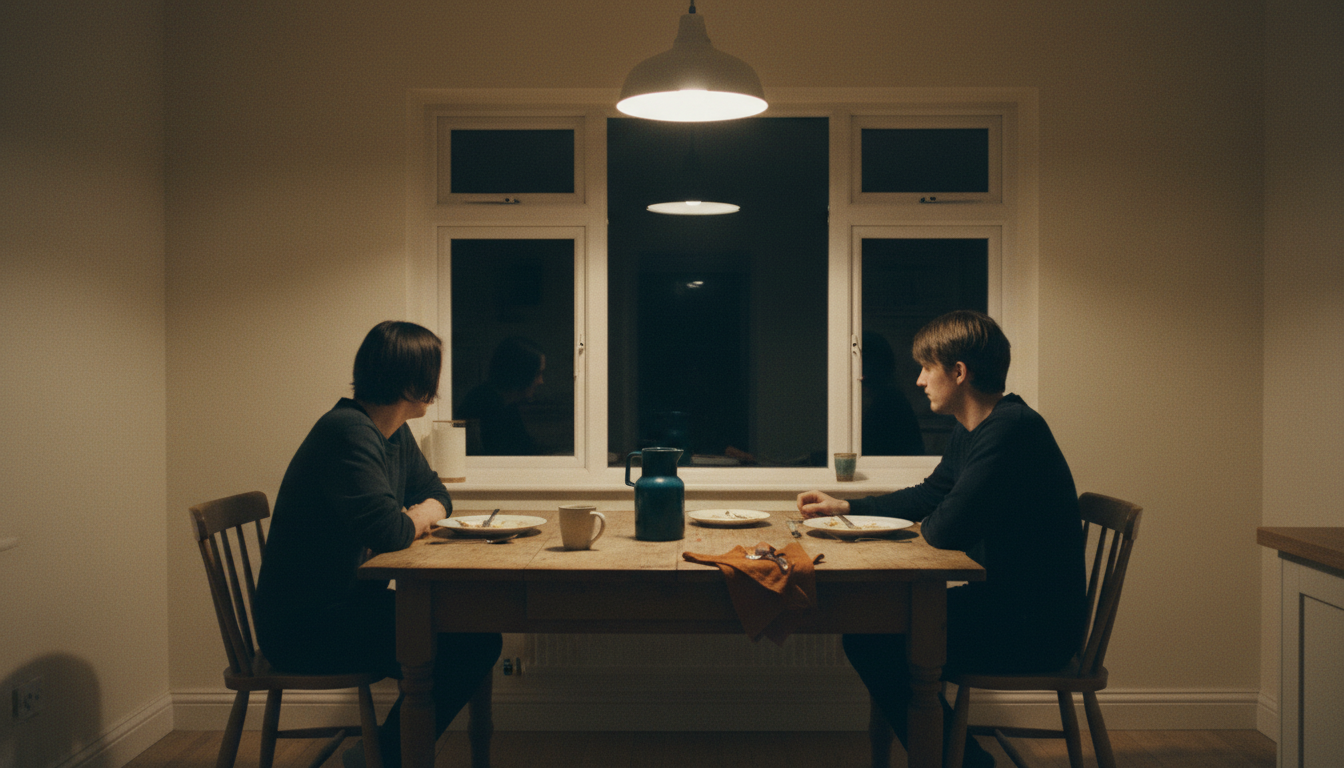
The plates are still out at nine and your partner has answered three questions in four words each. You ask whether something is wrong. Nothing is wrong. You ask again, slightly differently, and the room changes temperature. The rest of the evening goes into the conversation about the conversation, which is the one conversation that never lands anywhere. The question worth asking is not how to make them talk. It is what the quiet is actually made of.
Quiet is not one thing. From across the room it looks identical, but it is at least four different states, and they call for opposite things from you.
The first is a body in alarm. John Gottman's writing on what he calls flooding describes a heart rate above about 100 beats per minute, at which, in his account, a person stops taking in what is being said and either escalates or goes still. The Gottman Institute traces the pause to the adrenaline still circulating and the twenty minutes or more it takes to clear, and describes one of its laboratory studies in which couples who were interrupted mid-disagreement and asked to read magazines for half an hour came back to the same topic with lower heart rates and a more productive conversation. Nothing was understood better during those thirty minutes. The person simply came back.
The second is a case that was argued somewhere earlier and closed. They had the conversation in their head on the drive home, arrived at a position, and are not going to reopen it at nine at night. This quiet is not the absence of a thought. It is a thought that has finished.
The third is about the topic rather than the person, and it has the clearest research behind it. In a study of 31 couples published in the Journal of Personality and Social Psychology, Andrew Christensen and Christopher Heavey asked each couple to discuss one change the husband wanted and one change the wife wanted. Both partners pressed harder on the topic that was their own and withdrew on the topic that was the other person's. The same two people, the same evening, two topics, two different behaviours. That is the cycle researchers call demand and withdraw, and in that study it followed the topic rather than how either partner felt about the other.
The fourth is a penalty, and it is the only one on this list that is aimed at you. In the ostracism research that begins with Kipling Williams, undergraduates asked to describe receiving the silent treatment reported the same four things under threat: belonging, self-esteem, control and a sense of mattering. In a later study by the same team, people who could not explain why the silence had started reported the greatest threat of all, which is the finding worth keeping. Ambiguity is the part that hurts. The same team also found the two sides describing one event in opposite terms: the person who went quiet remembered a tactic that worked, and the person who received it remembered withdrawal and resentment.
That last pair of findings is the reason to change what you do first. From the outside you cannot tell which of the four you are looking at, which is why the move below is the one that costs the least if you have guessed wrong.
The one opening
Say the observation once, and make the silence cheap to explain. Something close to this: you have gone quiet, and I am not going to guess at it. If it is the day, that is fine. If it is the topic, we can leave it until tomorrow. If it is me, tell me when you can.
Then stop, and mean the whole approach rather than the sentence. The second ask is what turns a silence into an argument, and it is the second ask that the flooding research predicts will fail.
Then name a time. Tomorrow, ten minutes, after dinner. A time is what separates I do not want to talk about this now from I am not going to talk about this at all, and it removes the ambiguity the ostracism studies point at.
If you are the one who goes quiet, the same move works in reverse and costs one sentence: I am not ready for this tonight, and I am here for it tomorrow at six. You do not owe an explanation at that point. You owe the appointment.
What to notice afterwards is which of the four it was, and whether the quiet ended near the time you named. Write one line about the answer, not about the tone.
What this will not do
It will not produce the conversation tonight, and it is not built to. It will not turn the punitive version into a misunderstanding either. When the quiet is aimed at you, lifts only after you have accepted blame for something you cannot name, and runs as a pattern rather than a mood, that is a different phenomenon with a different literature, and nothing above is designed for it.
Nor will it tell you what your partner was feeling. Only they can, and only at the hour they choose. The move is to make that hour smaller: one sentence, one time, and no second ask.
The free Relationship Checkup is open to everyone, any time.
One question a week.
Each Sunday: one question to ask your partner, the research behind it, and one thing to try. The free Relationship Checkup is open to everyone, any time.